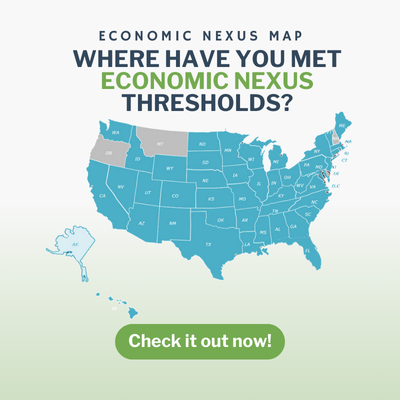
Growth is good for business. But as your sales expand into new states, your sales tax obligations can expand right along with them.
One of the most common ways businesses unexpectedly create sales tax exposure is through sales growth. A company may not open a new office, hire employees in another state, or establish a physical presence, but simply increasing sales into a state can create an obligation to collect and remit sales tax.
That’s because of economic nexus.
What’s at Stake?
Following the Supreme Court’s 2018 decision in South Dakota v. Wayfair, businesses can establish sales tax obligations based solely on economic activity within a state.
Today, most states impose economic nexus thresholds based on revenue, transaction volume, or both. As a business grows, it can cross one of these thresholds without its tax team realizing it in real time.
That means a business can be operating successfully, increasing revenue, and expanding its customer base while simultaneously creating new sales tax obligations.
And once an obligation exists, simply registering and collecting tax going forward may not address the full exposure.
How Sales Growth Can Trigger Sales Tax Nexus
Economic nexus thresholds vary by state, but the basic concept is consistent: a business does not necessarily need a physical presence in a state to have a sales tax collection obligation.
As sales increase, businesses should regularly evaluate their activity by state to determine whether they have crossed a state's economic nexus threshold.
This is especially important for companies experiencing:
- Rapid revenue growth
- Expansion into new markets
- Increased online sales
- Growth in customer or transaction volume
- Expansion of SaaS, digital products, telecommunications, or professional services
A state-by-state review can help identify where obligations may have already been triggered and where a business may be approaching a threshold.
Immediate Response Steps
If your business is growing rapidly or expanding into new states, there are several steps you should take to evaluate your sales tax exposure.
1. Evaluate Your Nexus Footprint
Start by reviewing your sales activity by state over the trailing 12 months.
Look at both revenue and transaction volume, where applicable, and compare your activity against each state's economic nexus threshold.
The goal is to identify states where your business has already exceeded a threshold as well as states where you may be approaching one.
Regular nexus reviews are particularly important during periods of rapid growth because your footprint can change quickly.
2. Determine Product and Service Taxability
Crossing an economic nexus threshold does not automatically mean every product or service you sell is taxable.
Once nexus has been established, you also need to determine whether your specific products or services are taxable in that state.
This can become particularly complicated for businesses selling:
- SaaS and cloud-based software
- Digital products
- Telecommunications services
- Professional services
Taxability rules vary by state, so a product that is taxable in one state may not be taxable in another.
That means a nexus review and a taxability review need to happen together.
3. Evaluate Voluntary Disclosure Opportunities
What happens if your review reveals that you've already established nexus in a state but haven't been collecting and remitting sales tax?
A Voluntary Disclosure Agreement (VDA) may be an option.
VDAs can help businesses address historical sales tax exposure with a state before the state initiates contact. Depending on the state's program and circumstances, a VDA may provide:
- Penalty relief
- A reduced lookback period
- Lower audit exposure
- Greater control over the timing of remediation
One important consideration: VDAs are generally only available before a state contacts the business.
For that reason, identifying exposure proactively can give a business more options for resolving it.
4. Register and Begin Compliance
Once sales tax obligations have been confirmed, the next step is to register appropriately and begin collecting and remitting tax prospectively.
This includes making sure the business has the appropriate registrations in place and processes established for ongoing compliance.
But registration shouldn't be viewed as the end of the process.
Businesses should also have a system in place to monitor sales activity and nexus thresholds going forward.
Why Growth Should Trigger a Sales Tax Review
Sales tax compliance shouldn't be something a business evaluates only after receiving a notice from a state.
Growth itself should be considered a trigger for reviewing sales tax obligations.
When revenue increases, customer bases expand, or a company enters new markets, the sales tax footprint can change along with the business.
A regular review of sales activity by state can help identify exposure before it becomes a larger problem.
And if exposure already exists, addressing it proactively may provide more options than waiting for a state to identify the issue first.
Don't Let Growth Create an Unplanned Tax Liability
Expanding into new states is an exciting milestone for any business. But with growth comes additional sales tax complexity.
Businesses should regularly evaluate:
- Where they are making sales
- How much revenue they are generating in each state
- Transaction volumes
- Whether economic nexus thresholds have been exceeded
- Whether their products and services are taxable
- Whether historical exposure needs to be addressed
The earlier these questions are addressed, the more control a business has over the outcome.
Sales growth should be a reason to celebrate, not a reason to discover an unexpected sales tax liability years later.
If your business is growing into new states, now is a good time to evaluate your nexus footprint and make sure your sales tax compliance strategy is keeping pace with your growth.
Want to know what to do when a sales tax problem finds you?
Read the full Sales Tax Incident Response Kit for practical guidance on six common events that can trigger sales tax risk and the immediate steps your business can take to assess exposure, address issues, and strengthen your compliance processes.
.png?width=250&height=66&name=TaxConnex_logo_withoutTagline_R%20(1).png)
.png?width=225&height=59&name=TaxConnex_logo_withoutTagline_R%20(1).png)